Many local specialists don't charge for a mold inspection in Charleston; ask when they call. A thorough one includes going into the crawl space, wood moisture readings on joists and subfloor, humidity measurements, and photographs. Lab testing runs $300–$900 when it is warranted, and EPA guidance holds that visible mold with a known water source generally does not need testing first.
Here's what gets measured, and how to vet a company in a state with no mold license.
The crawl space is not optional
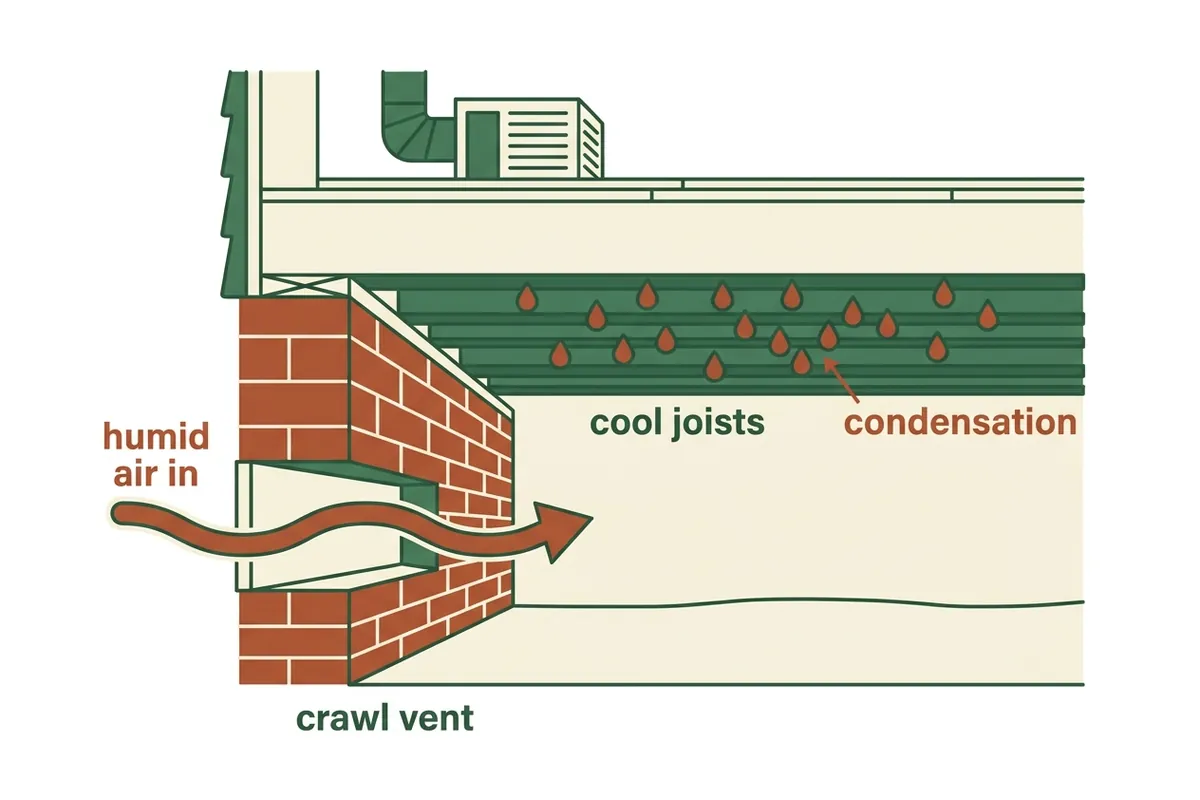
An inspection here that doesn't go under the house is guessing. Most Lowcountry mold problems either start in the crawl space or are being fed by it, and the evidence: condensation on joists, sagging wet insulation, a vapor barrier that has torn or was never installed, standing water, is only visible from down there.
What a good inspection writes down: moisture content on joists and subfloor at named spots, relative humidity in the crawl compared with inside the house, how well the vapor barrier covers and what shape it is in, insulation and ductwork condition including any condensation, standing water and its source, and the grading and downspout outlets outside that feed it.
What gets measured upstairs
- Moisture readings at wall bases and any suspect surface, recorded by location
- Indoor temperature and relative humidity, compared against the crawl space numbers
- The air handler, return, and accessible ductwork
- Attic and bath fan terminations, where accessible
- Exterior walk: grading, downspouts, flashing, and evidence of tidal or storm intrusion
- Thermal imaging and a borescope where a cavity needs assessment without demolition
When testing is worth it, and when it isn't
The plain truth: when you can see the mold and you know where the water came from, a lab result rarely changes the next step. The removal is the same whatever species the lab names, and EPA guidance says as much. A company that wants to test every visible patch is charging you for reassurance.
Four cases justify a test. A smell with no source you can find, after meters have been used. A health question where you need paperwork. A real estate transaction, which is common here and often the reason for the call. And checking after remediation, the one case where a test is clearly worth the money, because it shows the work did its job.
No state license means you do the vetting
South Carolina has no mold-specific contractor license. Florida and some other states license mold assessors and remediators separately and bar one firm from doing both on the same job, so that whoever sizes the job is not paid by its size. South Carolina has nothing like that, so that check falls to you.
Three checks do most of the work. Look up general contractor licensing through SC LLR. Ask which independent certification the technicians carry, who issued it, and whether it is current. Ask to see the moisture readings that support the recommended scope. Put all three to the specialist; a company that bristles at them has told you what you need to know.
Do you need testing, or do you need the source found?
Most people call having already seen or smelled something. Testing tells you what is in the air; it does not tell you where the water is coming from, and in this market the water is usually the whole answer.
| Method | What it answers | What it cannot tell you |
|---|---|---|
| Visual inspection | Where growth is and what it is growing on | Nothing about what is behind a finished surface |
| Moisture mapping | Where the material is wet right now | How long it has been wet, or what grew while it was |
| Surface sampling | Whether a specific patch is mold and roughly what kind | Whether the rest of the house is affected |
| Air sampling | Airborne spore levels against an outdoor baseline | The source: a high reading still leaves the hunt ahead of you |
South Carolina issues no mold-specific contractor license, so verifying general contractor licensing and independent certification matters more here than in states that do. Be especially wary of free testing offered by whoever also wants the remediation contract.
Inspection questions, straight answers
Does the inspection include going under the house?
A good inspection includes going under the house, and it's the part that usually finds the answer. A mold inspection in this market that skips the crawl space has skipped the diagnosis. Most Lowcountry mold problems either originate down there or are being fed by it. It should include moisture content readings on joists and subfloor, not just a look around.
Do I actually need a lab test?
Usually no. EPA's position is that visible mold with a known water source generally does not call for testing, since the species does not change the removal. A test earns its fee when an odor has no findable source, when a doctor or lawyer needs documentation, when a house is changing hands, or when a completed job needs confirming.
What does an inspection cost?
Many local specialists don't charge for the visual inspection; ask when they call. A proper one goes into the crawl space and takes moisture readings. If lab testing is truly needed, it usually costs $300 to $900, depending on how many samples and whether air sampling is part of it. Before any test is ordered, ask whether its result would change the plan.
How do I vet a mold company in South Carolina?
It takes more effort than in a state with a mold license, since South Carolina has none. Look up general contractor licensing through SC LLR, ask which independent certification the technicians hold and who issued it, and ask for the moisture readings the scope is based on. A company with no readings to show is selling, not diagnosing.
What should a real inspection report include?
Moisture readings at named spots, the crawl space included; relative humidity under the house and inside; photographs; the moisture source, identified; and a scope tied to what was found. A report that gives a price without saying where the water came from is a sales quote dressed as a diagnosis.
Get a Charleston mold inspection
Tell us what you’re seeing or smelling: a musty smell coming up through the floor, cupping hardwood, condensation on ductwork, staining on a wall, and we'll pass your request to one independent local specialist, who can set up an inspection. A specialist who serves the Charleston area will call you back.